Regular progress updates
Test scores, the chapters that are strong, and the ones that need work, shared in plain words.
The Weekly Doubt-Free Plan
Beena’s method is not a secret formula. It is a calm, repeatable week: Simplify, Practise, Clear, Check. Kept up all year, it turns Physics from the subject a student avoids into the one they are proud of.

Why weekly matters
A doubt that is not cleared this week makes next week’s chapter harder. Over a term, a few small gaps become the wall a student meets on exam eve.
The Weekly Doubt-Free Plan works by never letting that pile start. Every week ends with a doubt clinic, so the count goes back to zero before the next chapter begins.
The graph is an illustration of the idea, not data from a study.
The four beats
A new idea is introduced from something the student already knows, then built up in small steps. Beena draws as she explains: field lines, rays, circuits and graphs appear on the board one line at a time, so the picture and the equation grow together. Where a Grade 11 idea is missing, it is fixed on the spot.
Guided numericals are solved together using one fixed routine. Then students try independent problems from NCERT, exemplar and past board papers on a worksheet matched to that week’s lesson. The aim is not more problems. It is the right problems, done properly.
Students bring every doubt from the week, big or small. It is a judgement-free space: “I didn’t get any of it” is a welcome answer. Nothing unresolved is carried into the next week.
A short weekly test shows what has truly landed. Each student gets individual feedback, and parents receive regular progress updates, so everyone sees the trend early and gaps are closed while they are still small.
Try it yourself
This is the routine every PhysicsMentor student learns. Reveal each step and notice how little there is to fear.
Question. A cell of emf 12 V and internal resistance 1 Ω is connected to a 5 Ω resistor. Find the current in the circuit and the voltage across the resistor.
Sketch the loop. Mark the current leaving the positive terminal of the cell. A drawing turns words into something you can see.
E = 12 V, r = 1 Ω, R = 5 Ω. Find I and V across R.
The same current flows through the resistor and through the cell’s own resistance, so the total resistance is R + r.
I = E / (R + r)Voltage lost inside the cell: I × r = 2 × 1 = 2 V. Add it to the 10 V across R and you get 12 V, the emf. It balances.
Oh, it was that easy.
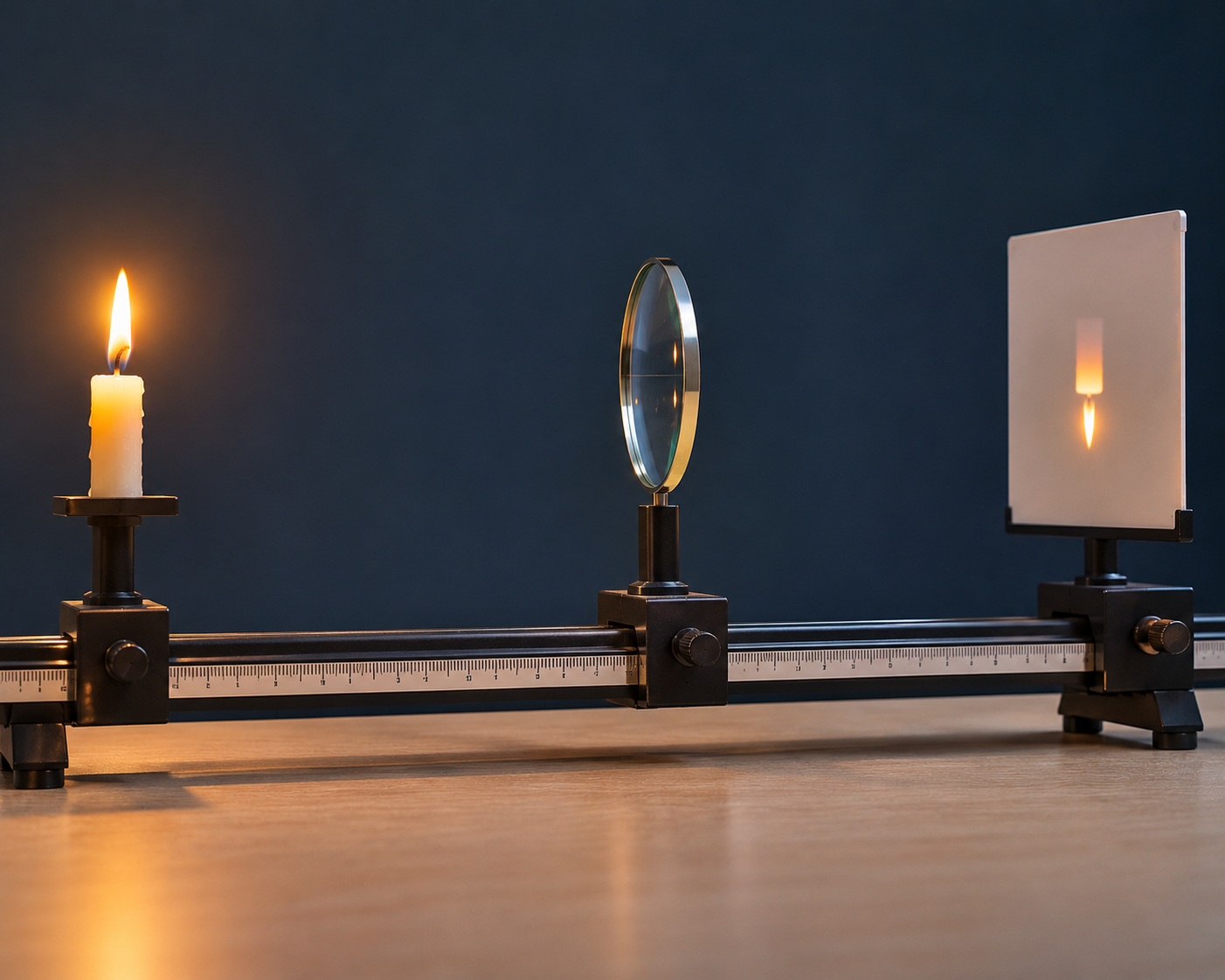
See it before you solve it
Whenever a topic can be shown, it is shown first. A lens on a bench, a circuit on a table, a block on a slope. When the picture is in the student’s head, the equation has something to describe.
The extra ingredient
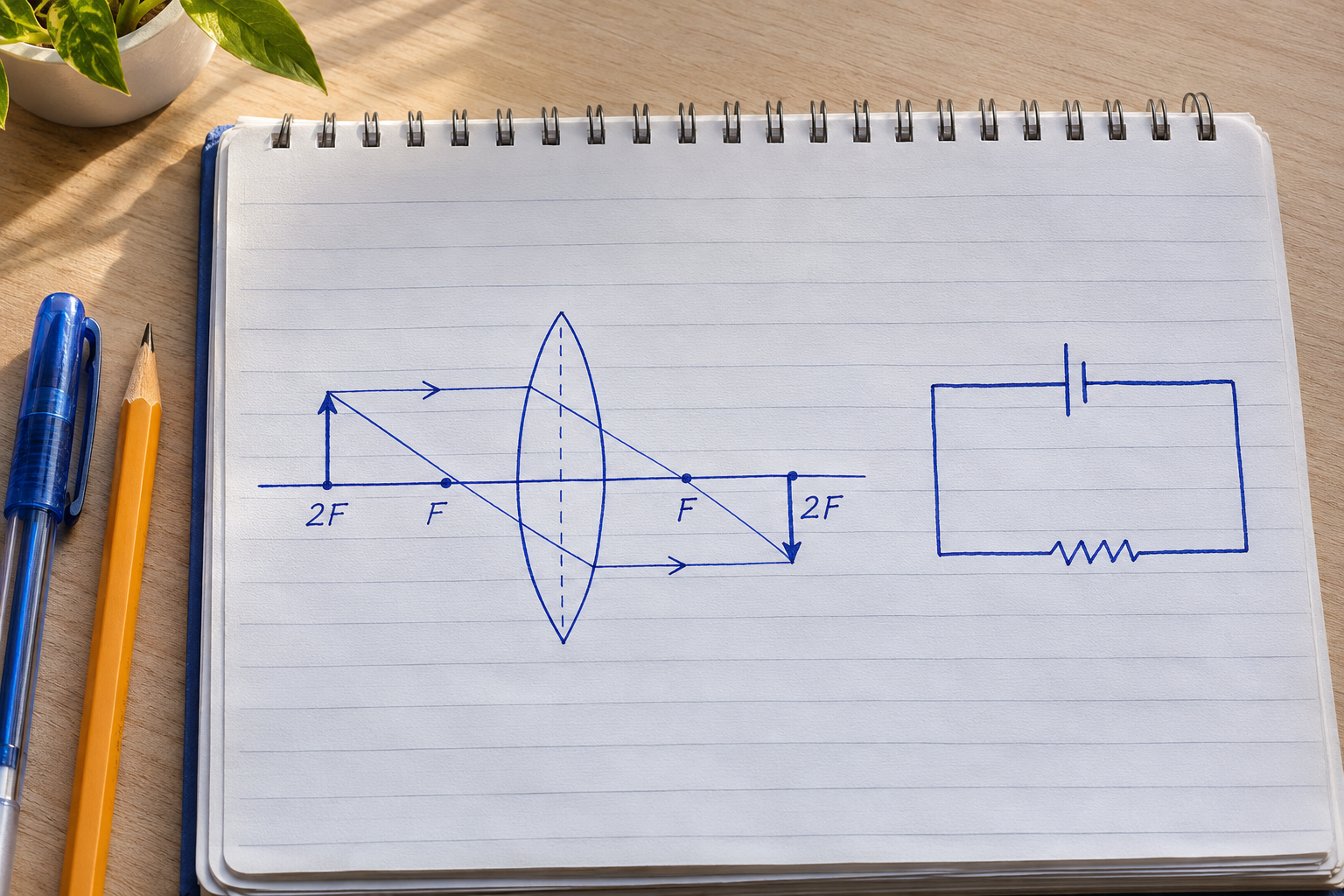
Beena has always loved painting and drawing, and her board work shows it. Ray diagrams, electric field lines, magnetic fields around a wire, phasor diagrams for AC: each is sketched slowly, line by line, until the student can see what the equation is describing.
Students then draw them back. A diagram a student can draw from memory is a concept they understand, and in a board paper, a clean labelled diagram earns marks on its own.
For parents
Parents see the effort and the marks, and often cannot see what lies between. PhysicsMentor makes that middle part visible.

Test scores, the chapters that are strong, and the ones that need work, shared in plain words.
If a gap appears, you hear about it while it is small, with a plan for fixing it.
Questions about progress, exams or the timetable are welcome on WhatsApp.
How classes run
Six to eight students at most, on camera, with the board shared on every screen. Beena sees every face and every page of working.
Doubts are asked out loud, or in the chat if that feels easier.
The same live classes, the same doubt clinic and the same weekly test, from any city or home. Diagrams are drawn live on a digital board.
Not recorded lectures. A real teacher, in real time.
See it for yourself
Start with a free demo class and feel the difference a clear explanation makes.